6 ways directors end up with an overdrawn loan account

Pay for a personal Amazon order on the company card because it's the one in your wallet, and tell yourself you'll transfer the money back later that day.
That single payment, small as it is, has just created a director's loan.
It sounds strange to call it a loan when it's "your" company - but legally the company's money isn't your money. It only becomes yours once it's paid out properly, as salary, a dividend, or an expense reimbursement. Anything else is borrowing, even from yourself.
Leave it unlogged and unrepaid, and it can quietly become an overdrawn director's loan account - the kind that HMRC has very specific rules about.
A director's loan account (DLA) tracks every bit of money moving between you and your limited company that isn't salary, a declared dividend, or a genuine business expense reimbursement. Most directors don't set out to borrow from their own business. An overdrawn balance usually accumulates through everyday decisions that felt harmless at the time.
Where the overdrawn balance usually comes from:
- A personal purchase on the company card. A subscription, a meal, a train ticket bought because the company card happened to be in your hand.
- Drawing cash against a dividend that hasn't been declared. Until the paperwork exists, it isn't a dividend, it's a loan.
- Expense claims that don't survive a closer look. Costs that are only partly business, like a phone contract or a subscription claimed in full.
- The company paying a personal bill directly. A tax bill, a family member's expense, or a personal insurance premium straight from the business account.
- Clearing the balance and redrawing it soon after. Repaying an overdrawn loan of £5,000 or more and taking a similar amount back out within 30 days doesn't reset anything.
- A string of small draws nobody's tracking cumulatively. No single one on its own looks like a loan.
What an overdrawn balance costs
The consequences depend on how large the balance gets and how long it stays open.
If the loan is still outstanding nine months and one day after the company's accounting year end, the company faces a corporation tax charge under Section 455 of the Corporation Tax Act 2010.
It's calculated at the dividend upper rate: 33.75% for loans made before 6 April 2026, rising to 35.75% for loans made on or after that date, following the Autumn Budget 2025 changes to dividend tax rates. The charge is refunded once the loan is repaid, though the refund itself only arrives nine months after the end of the accounting period in which the repayment happened.
Separately, if the balance goes above £10,000 at any point in the tax year and the director isn't paying interest at HMRC's official rate (3.75% for 2026/27), the difference is treated as a taxable benefit in kind.
That means it goes on the company's P11D, income tax for the director through self-assessment, and Class 1A National Insurance for the company. This applies to nearly all owner-managed limited companies, which count as "close companies" under HMRC's rules.
A balance doesn't need to be large to trigger both charges at once.
£12,000 sitting open at year end brings the benefit-in-kind charge into play, and the s455 charge on top of it if it's still there nine months and a day later.
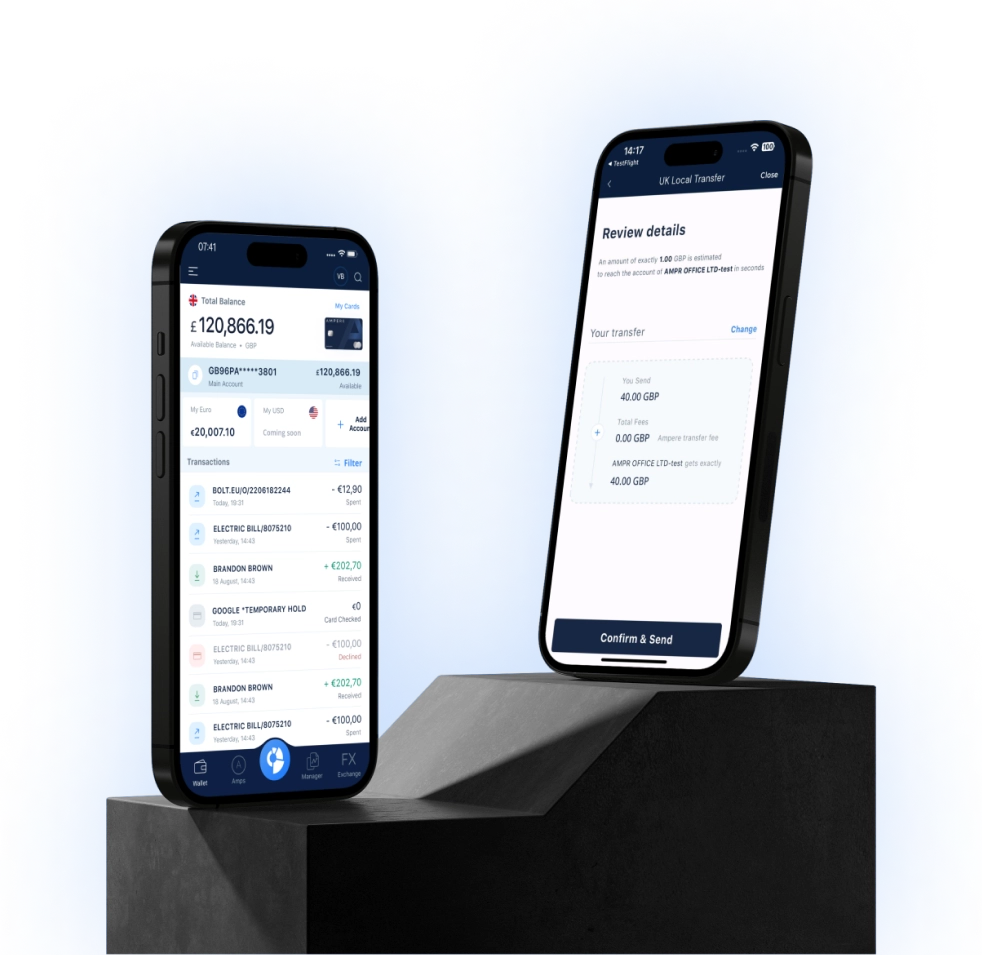
Keeping personal and company spending apart from the start is the simplest way to stop a DLA from forming by accident. Open a dedicated Ampere business account and keep every card transaction in one feed, so a personal purchase is easy to catch and repay the same week.
The fix is mostly about timing. Catching a personal payment the week it happens and repaying it before the next board meeting keeps the DLA at zero or close to it.
Catching it nine months later, after the accounting year has already closed, is what turns a small oversight into a tax bill.