
Ask what an international payment costs, and you'll get the transfer fee back as the answer. £15, £25, sometimes nothing at all if the provider's feeling generous, but that number is almost never the real cost.
The real cost sits inside the exchange rate itself, in the gap between the rate you're given and the rate that exists on the wholesale market at that moment.
That one has a name: the mid-market rate, the number you'd see on Google or Reuters. It's what banks and large institutions trade at with each other, and it's the only version of "the exchange rate" that isn't already tilted in someone's favour.
Currency conversion is a profitable business, and quoting a slightly worse rate than the mid-market one is how a large share of that profit gets made.
What hidden exchange rate fees cost
A UK-wide study published in August 2026 put hidden exchange rate fees to the test. Sixteen providers, one simple transfer, £1,000 from GBP to USD. The results ranged from honest to actively misleading:
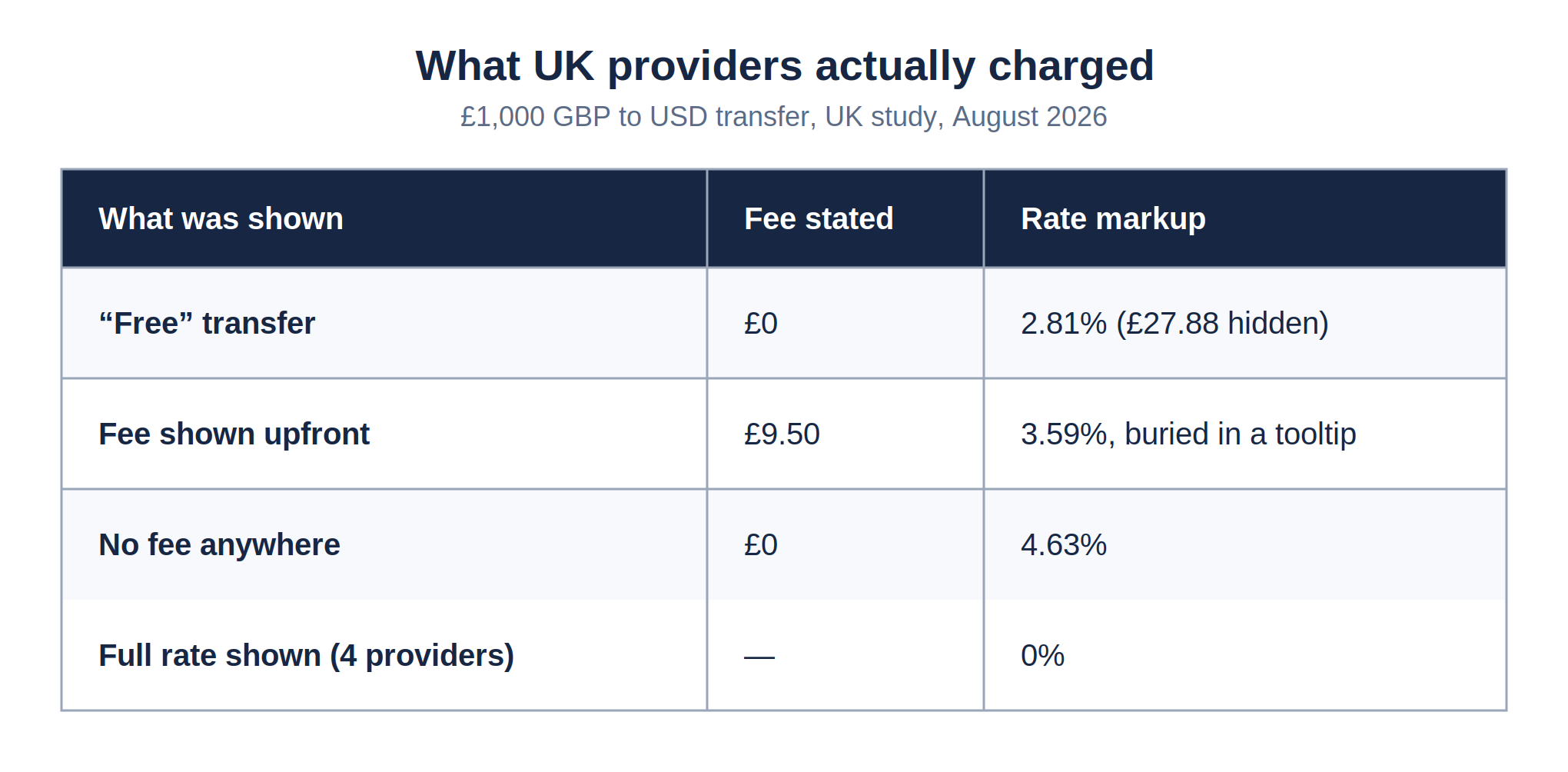
None of those four are hard to access. Transparent pricing costs nothing to offer, it's just a choice some providers make and others don't.
Scale that 2.81% markup up to a £50,000 supplier payment and the hidden cost is roughly £1,400, more than most finance teams would ever question on a cost they could see. Pay that supplier monthly for a year and it's over £16,000 gone. Not from a fee anyone signed off on. From an exchange rate nobody checked.
Since 2023, FCA rules have said firms must be clear and honest about what a currency conversion costs, and that covers the markup inside the rate, not just the fee on the label.
So the rule already exists - what’s been missing is consistency in following it.
When the FCA reviewed the market itself, it found the same things this piece has been describing: "no fixed fee" presented as though that meant no cost at all, markups left unexplained, correspondent bank charges kept quiet until after the money moved. It called all of that poor practice, in writing.
A "free" transfer hiding a 2.81% markup is the exact thing the regulator has already named, which means you're well within your rights to ask any provider what their markup is.
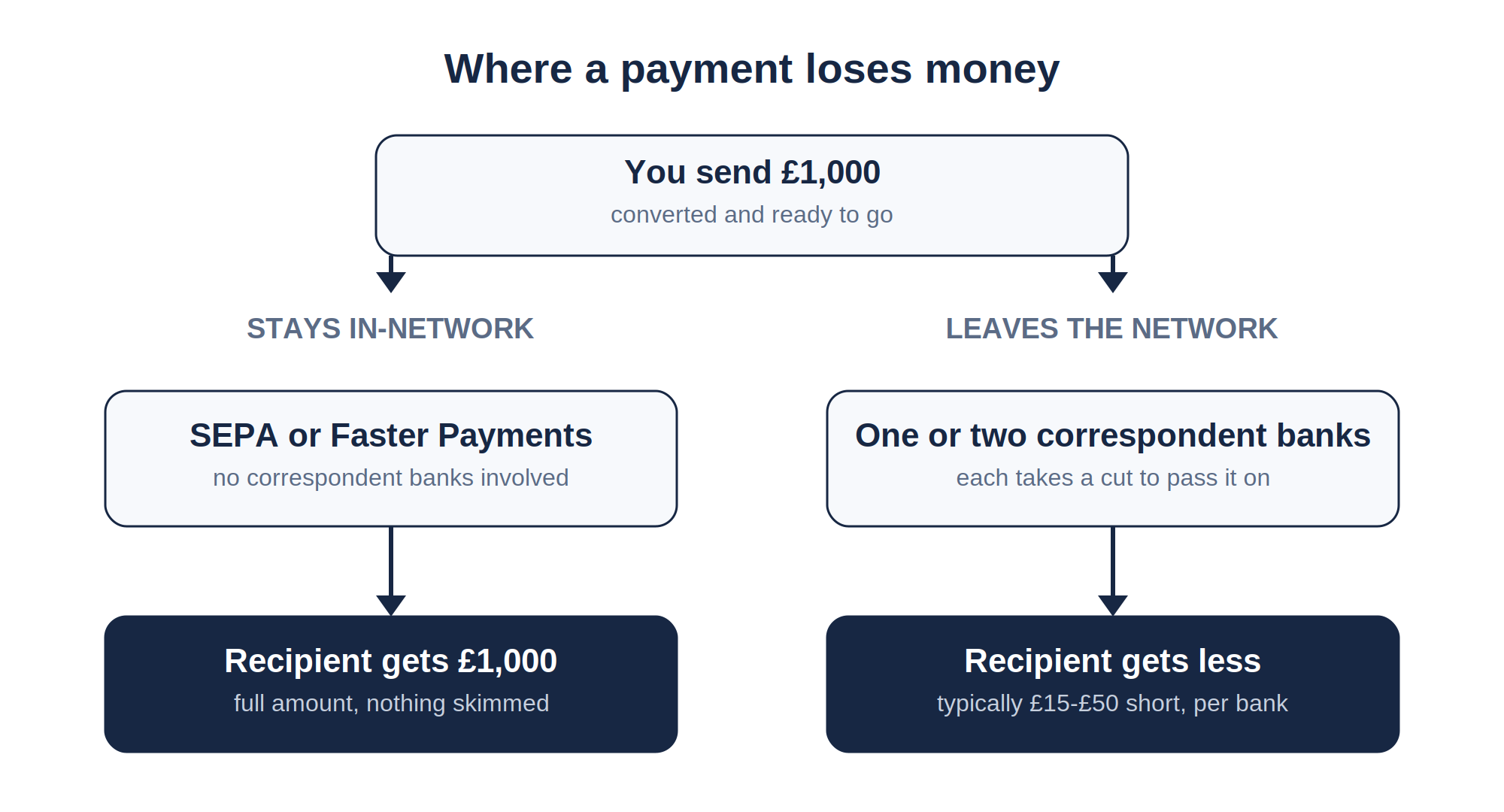
There's often a second layer sitting on top of the markup, and it has nothing to do with the exchange rate at all. Most international payments still travel over SWIFT, a messaging network that connects banks but doesn't move money directly between just two of them.
A payment hops instead. One correspondent bank, sometimes two, each acting as a stepping stone toward the recipient's bank, and each entitled to a small cut, typically £15 to £50.
Sometimes that cut gets deducted from the amount that arrives rather than billed separately.
Your statement shows the full amount sent.
Your supplier's statement shows less landing.
Somewhere between the two, a bank you've never heard of took a fee you never agreed to.
This doesn't hit every payment. A transfer that stays inside one network, SEPA for euros, Faster Payments for sterling, skips the step entirely. It's the payments leaving those networks, usually wires in currencies like USD, that pick up a correspondent bank or two.
Ampere's multi-currency account sidesteps that: GBP and EUR balances in one place, a UK IBAN and sort code sitting alongside an EU IBAN on the same account.
Paying a supplier in euros, or getting paid in them, skips the conversion entirely when you're already holding the currency you need. No correspondent bank taking a cut. Local transfers on both rails are free.
Ampere shows its margin upfront: 0.35% on GBP and EUR, 0.55% on USD and CHF, applied on top of the European Central Bank's reference rate. That's a published daily rate rather than a live feed, so it won't track mid-market to the decimal, but both the benchmark and the margin are public.
The final figure appears before you approve the payment, markup included.
That's the same shape as the transparent providers in the table above, and a different order of magnitude from 2.81% sitting inside a transfer advertised as free. Still a cost. Just one you can see before you agree to it.
Checking a business currency conversion rate
Every business currency conversion comes down to two numbers: the rate on screen, and the mid-market rate at that same moment. The second one is a quick search away on Google or XE, and it's the only reliable way to tell a fair rate from a padded one. The payment screen was never going to volunteer the difference.
Card payments have a version of the same problem, and it shows up differently. The rate you see at checkout isn't always the rate you settle at.
Providers often price card transactions off a rate fixed for a day or a week, so a Friday evening purchase can clear on Monday against a rate that's moved. Nobody's hiding a markup here, just leaving a gap between the number you saw and the number you get charged.
It’s small on a single purchase. Less small across a year of recurring software subscriptions and supplier payments in other currencies.
A few habits close most of the gap:
- Compare the quoted rate against the mid-market rate before agreeing to anything
- Consolidate smaller, frequent payments into fewer, larger transfers, since providers are usually more willing to tighten the markup on bigger amounts
- Watch the timing: a rate set on a Friday afternoon can sit stale over the weekend, so a payment that could wait until Monday sometimes should
On the card side, Ampere shows the Mastercard exchange rate before a payment goes through, not after. That closes the gap: you're seeing the number that applies, not an estimate that might have moved by the time it settles.
Wait a day if the rate's against you, go ahead if it isn't, and either way you knew before you paid.
The closer those two numbers sit, the fairer the rate, whoever's showing it to you.