A business account is optional until it isn't

The £68 at the print shop could have been client proposals, or it could have been your kid's school project.
That subscription renewing every month might be software you use for work, or something you forgot to cancel two years ago.
Your account wouldn't really know.
Multiply that guessing game by every month you've been trading, and you get a rough sense of what running one account for everything really costs. That guessing game only stops once you settle the business vs personal account question.
When you register a limited company with Companies House, you create something separate from you. The company owns what it earns and what it owes. You're a director, maybe a shareholder too, but the money in the business belongs to the company, and it only becomes yours once it moves across as a salary or a dividend.
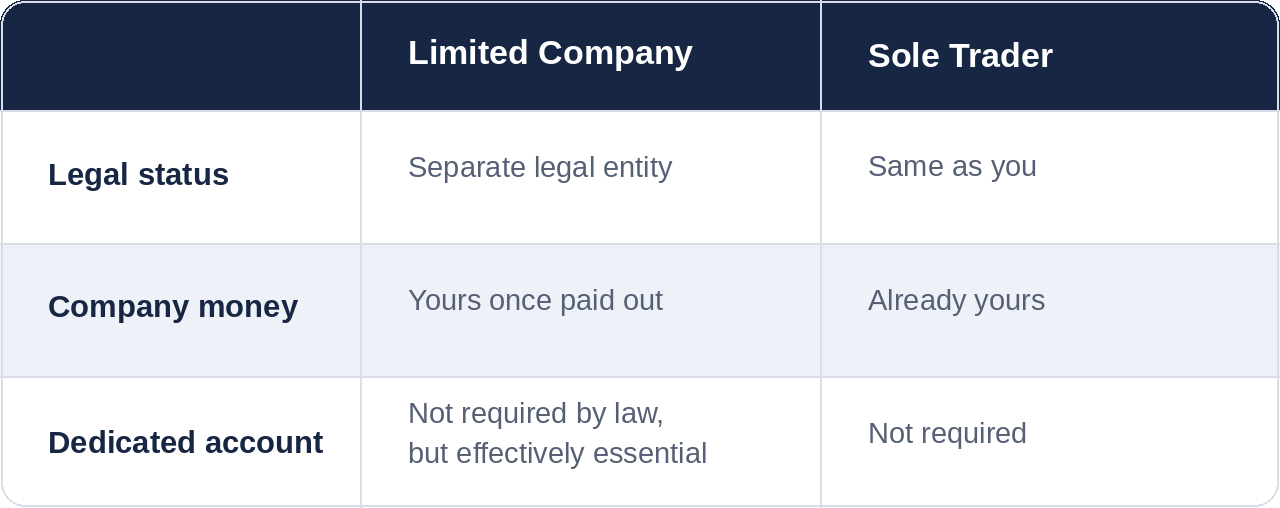
For sole traders, that last row is optional, at least on paper. You can run income and expenses through your personal account for as long as you like.
What's changed is Making Tax Digital: since April, sole traders with £50,000 or more in turnover have had to keep digital records of income and costs and send quarterly updates to HMRC.
Untangling business spending from a single blended account every three months gets old fast, and plenty of freelancers who start the year meaning to sort receipts at the end of it never quite manage.
What about limited companies?
The Companies Act 2006 requires every company to keep "adequate accounting records," entries good enough to show and explain the company's transactions and disclose its financial position with reasonable accuracy, at any given moment. It doesn’t name a business bank account directly, but it does spell out what the records need to cover:
- every sum of money that came in or went out, and what it was for
- a running record of what the company owns and what it owes
- enough detail for the accounts, once prepared, to be accurate
Try building that from a personal account where client payments sit next to your weekly shop and a birthday present for your nephew, and you'll see why almost no company manages without a dedicated one anyway.
Most personal account providers also block business use in their terms, so running invoices through one risks the account itself, besides, every transaction that needs a note explaining whether it was for the business adds time to your bookkeeping, and time on the clock adds up quickly by year end.
A dedicated account means the bank feed tells most of the story before anyone opens a spreadsheet.
Money that moves the wrong way, business funds covering something personal, usually gets logged as a director's loan. Leave it unpaid too long, and it can trigger a company tax charge nobody budgeted for. Personal cash covering a company bill works the same way in reverse - the company owes you, so it's good to keep track of it too.
If you've already been mixing the two
- Open a dedicated account and start routing new transactions through it from today. Don't try to fix the past.
- Reimburse yourself or the company, for anything currently sitting in the wrong place, so the movement is on record instead of buried.
- Log whatever you can't immediately unwind as a director's loan, so it's accounted for rather than ignored.
- Pick a cut-off date and work forward from it. Untangling a full year of mixed spending in one sitting usually creates more confusion than it solves.
A dedicated account solves the record-keeping problem.
Keeping personal spending cleanly apart from the business, even once you've drawn a dividend or director's salary out of the company, takes one more step. Ampere pairs a Business Card, issued directly from your company account, with a Private Card for money you've already taken out: dividends, a director's salary, or whatever else is now personally yours.
Two cards, two balances, no more guessing which receipt belongs where. Open a business account with Ampere and add both cards once your company's ready, and the monthly statement stops being a guessing game.
There's also the protection you set the company up for in the first place. Limited liability holds up because the company stays separate from you, financially as well as legally. Blur that line often enough, paying suppliers from your own account, taking client payments into it too, and a court or an HMRC investigation might start asking whether the company was ever really separate at all.
Keeping the two separate doesn't need a spreadsheet empire or an accountant on retainer. It just needs one account for the business, and one for you.