Profit vs cash flow explained

There's an old riddle about a tree falling in a forest with nobody around to hear it. Running a business comes with its own version.
If your company makes a profit and none of it is in the account, did it really make a profit?
Your accountant will say yes. Your landlord, still waiting on this month's rent, might want a longer chat about it. Both of them have a point, and the puzzle of profit vs cash flow sits somewhere between the two.
Profit
Profit is what's left after you take your costs away from your sales.
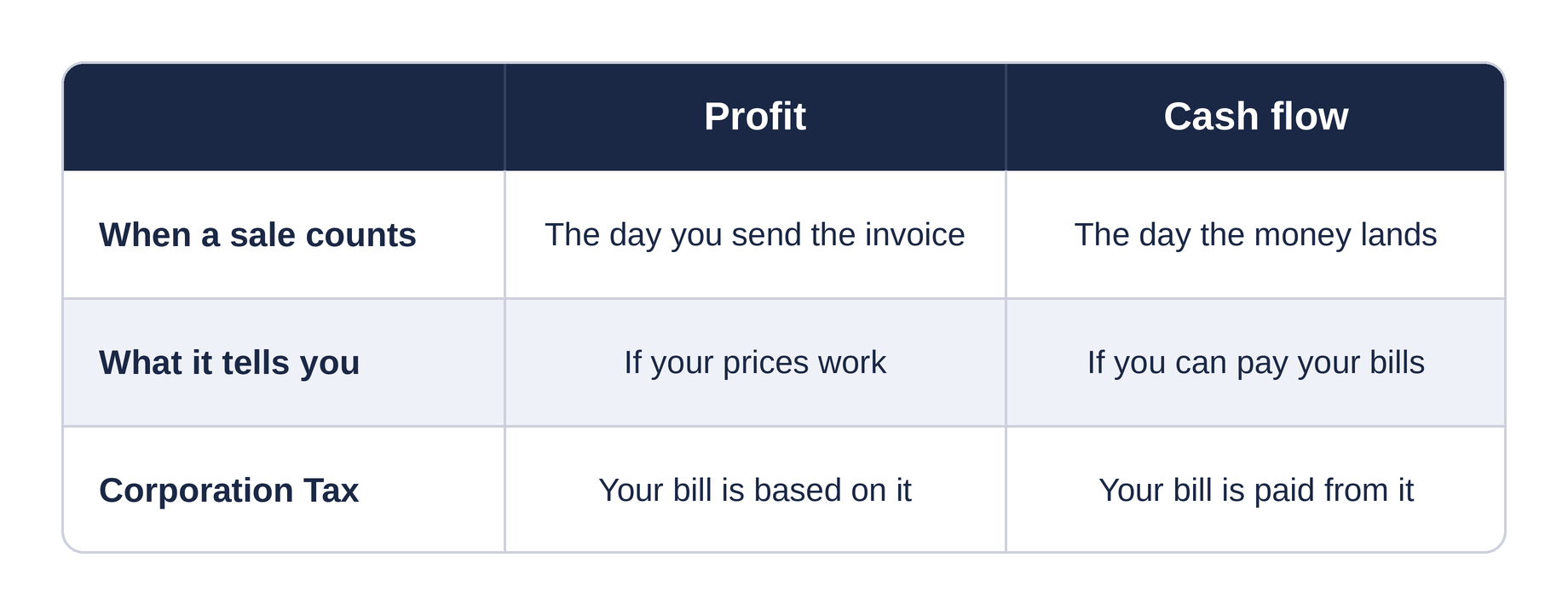
In your company's accounts, a sale counts the day you send the invoice. The customer might pay next week, or in three months, or after four polite reminders and one slightly less polite one. Your profit figure already includes the money either way.
So profit shows you if your prices work and if you're earning more than you spend.
Cash
Cash flow is the money coming into your account when customers pay, and going out when you pay everyone else.
Whatever's left has to cover salaries, rent and anything else due this week.
The biggest difference between cash flow and profit is about timing.
Give it long enough and the two usually catch up with each other. The problem is that a business can run out of money while it waits.
A profitable business can run dry because of something like:
- Customers paying late.
- Stock you've paid for but not sold.
- Big purchases.
- Loan repayments.
- Growing fast. Bigger orders mean paying for materials and staff before the customer pays you.
Tax bills also add to it.
Corporation Tax is based on your profit, but you pay it from the money in your account. For most small companies, it's due 9 months and 1 day after the end of the accounting period.
VAT can land you in a similar spot. On the standard scheme, you owe VAT on the invoices you've sent in the quarter. If slow payers are a regular headache, you can use the VAT Cash Accounting Scheme (as long as your turnover is £1.35 million or less) and pay VAT once your customer has paid you.
Every time a payment lands, move a slice of it into a separate pot for tax. Future you will be very grateful.
Send the invoice as soon as the job's done with a clear due date, and chase the day after it passes. If the customer is another business, you're also allowed to charge interest when they pay late.
Taking card payments helps as well, because customers pay at checkout and the waiting mostly disappears. With an Ampere merchant account, you can take Visa and Mastercard right on your website. Start taking card payments with Ampere and spend less time chasing payments.
For a cash flow forecast a simple spreadsheet is plenty.
Write down what you expect to come in and go out each month for the next few months, including tax bills and loan repayments. If it shows a gap in two months time, you've got two months to sort it.
Chase your biggest unpaid invoices first. Then look at what's going out. A new laptop or a big stock order can often wait a few weeks until the money's in. If you buy from the same suppliers regularly, ask whether they'll give you longer to pay.
If a tax bill is the problem
Sometimes the gap comes from a tax bill you can't cover in one go.
Call HMRC before the deadline and ask about a Time to Pay arrangement. You pay what you owe in monthly instalments, with interest added, so the bill gets spread out and a little bigger.