How Good Is Your Gearing Ratio?

Ironic, but borrowing money gets easier the less your company needs it.
Lenders like businesses that already look comfortable, and one percentage from your balance sheet tells them a lot.
That percentage is your gearing ratio, and lenders check it early when your company applies for a loan. It shows how much of your business runs on borrowed money compared to money that belongs to the company itself.
Every company is funded in two ways. There's money you've borrowed, like business loans, overdrafts and finance agreements.
Then there's the company's own money, which is the share capital put in by shareholders plus the profits kept in the business over the years. Accountants call the second part equity.
Your gearing ratio compares the two. The higher it goes, the bigger the share of your business funded by borrowing.
The most common gearing ratio formula divides total debt by shareholders' equity, then multiplies by 100 to give you a percentage.
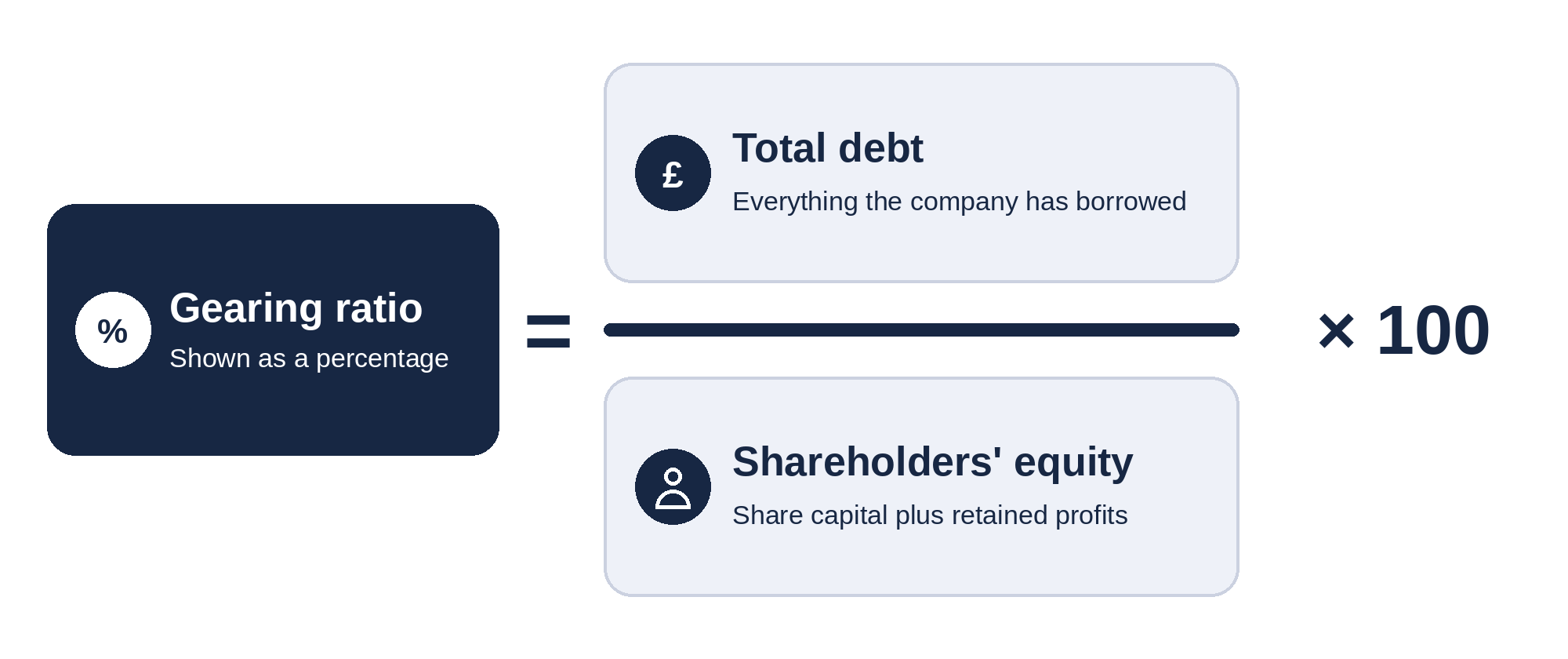
Total debt covers everything the company has borrowed, short-term and long-term. That includes business loans, overdrafts, hire purchase and any leases on your balance sheet.
You'll find both figures in your accounts, with equity near the bottom under "capital and reserves."
So if your company owes £40,000 across a loan and an overdraft, and its equity is £100,000, your gearing ratio is 40%. For every £1 of the company's own money, there's 40p of borrowing.
Some lenders use a version called net gearing, which subtracts the company's cash from its debt before dividing. A healthy cash balance pulls the figure down.
If a lender quotes a gearing number that doesn't match yours, ask which formula they used.
When a lender reviews your application, their biggest question is how likely you are to pay them back. Your gearing ratio shows them how much debt the business already carries before their loan goes on top.
Every loan comes with repayments and interest, and both come out of your cash flow. The more your company owes, the more of its income is already spoken for. If sales dip for a few months, you've got less room to cope.
Lenders also plan for the worst case - if a company is wound up, creditors get paid before shareholders, so a healthy chunk of equity gives the lender more of a cushion.
Some loan agreements go a step further and set a maximum gearing level as a condition of the loan, known as a covenant.
Lenders look at gearing alongside your cash flow, trading history and interest cover, which shows how many times your profit covers your interest bill. Gearing is the quickest of those to work out, so it often comes up early.
Many lenders will also ask for recent account statements to see money moving in and out of the business. Keeping your company's day-to-day payments in one dedicated account makes that part easier. With Ampere, you can open a business account online and get GBP and EUR accounts in one place.
So, what is a good gearing ratio? The right number depends on your company, but accountants and lenders commonly use these ranges as a starting point:
- Under 25% is low gearing. Lenders usually see it as lower risk.
- 25% to 50% is moderate gearing, often seen as a healthy balance.
- Over 50% is high gearing, which can work when profits are steady.
Your industry makes a big difference.
A construction firm or manufacturer needs expensive equipment and often carries more debt than a consultancy or software business. Lenders know this, so they compare your ratio with similar companies. A 55% ratio in a sector where most businesses sit around 60% looks pretty normal.
Very low gearing can mean the company has plenty of room to borrow, or that it's been cautious and passed on some chances to grow. For a loan application, low gearing works in your favour.
If your number is higher than you'd like, you can bring it down, though most options take a little time.
Paying off part of an existing loan cuts the debt figure directly. Profits you keep in the company add to retained earnings, which lifts your equity.
If you've lent the company money as a director, turning that loan into shares moves it from debt to equity in one go, but there are tax and filing steps involved. New investment from shareholders has a similar effect.
Lenders mostly work from your latest filed accounts, so changes you make today might not show until the next set. If you've paid down a big chunk of debt since your year end, up-to-date management accounts can show a lender where things stand now.