What Is a Chargeback, and What It Costs Your Business

A refund is something you choose to give.
A chargeback is something a customer takes back through their bank, without asking you first, and if your business takes card payments, you'll run into one sooner or later.
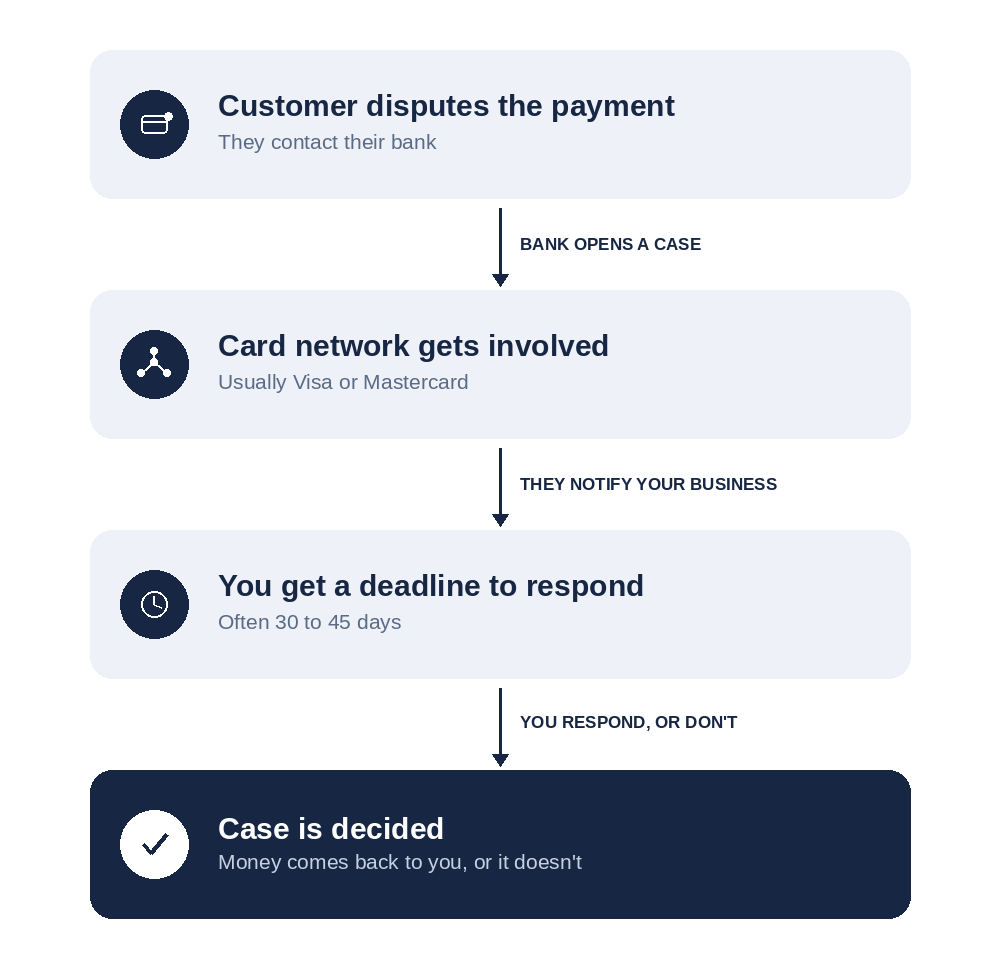
The process usually goes like this: the customer calls their card issuer and disputes the charge, citing fraud, a missing delivery, or an item that didn't match the description.
The issuer raises the dispute with the card network, Visa or Mastercard in most UK cases, which passes it to your acquirer. You get a notice with a reason code attached and a window to respond, often somewhere between 30 and 45 days depending on the scheme.
Miss that window, and the dispute is decided without you.
Not every chargeback is a genuine complaint.
Some are what the payments industry calls friendly fraud: a customer recognises the charge perfectly well but disputes it anyway, because a chargeback works faster than asking for a refund, or because they've simply forgotten making the purchase by the time the statement lands.
If the chargeback is upheld, the cost is straightforward at first.
You lose the transaction value, and you pay a chargeback fee on top, charged by your acquirer for handling the dispute.
Chargeback fees in the UK usually sit somewhere between £15 and £25, though they climb well past that for certain card schemes or for merchants flagged as high-risk.
The cost that's harder to see coming shows up later.
If you'd already shipped the goods, they're gone along with the money.
And if disputes start piling up, acquirers track your chargeback ratio. Cross a certain threshold and you risk a steeper pricing tier, or losing the ability to take card payments through that acquirer at all.
Acquirers build some of that risk into the account itself. Ampere's merchant account holds back a rolling reserve, a slice of what you take each day, for 120 days before releasing it: 5% for most sellers, rising to 10% for higher-risk categories. It's held aside specifically to cover chargebacks and refunds that come in after a sale has already settled.
The merchant dashboard gives you real-time visibility into your account, and Ampere's team works through disputes alongside you. Take a look at Ampere's merchant account.
A few habits cut down how often disputes land on your desk.
Clear product descriptions and honest delivery timelines head off a good chunk of "not as described" claims before they start.
Tracked shipping gives you proof if a customer says something never arrived. And a support inbox someone checks regularly gives customers somewhere to vent before they call their bank instead.
Customers have every right to dispute a charge, and plenty of those disputes are entirely fair. But knowing what triggers one, what it costs, and how fast you need to respond turns a stressful notification into something you can work through.