What Is a Sort Code and Where to Find Yours
You'll probably type your sort code hundreds of times while running your company, and never once wonder where it came from.
Those six digits have a surprisingly long history, and a pretty important job every time a client pays you.
A sort code is a six-digit number, written as three pairs like 12-34-56, that tells a UK payment which provider holds the account. Your account number, usually eight digits, then points to your exact account with that provider.
The quickest place to find yours is your app or online account. Most providers show the sort code and account number together under your account details. You'll also find them on your statements, and some providers print them on your card or in cheque books.
If you need someone else's sort code, ask them or check their invoice.
Larger providers use lots of different sort codes, so the provider's name alone won't tell you which one belongs to a particular account.
For anyone who's curious, the sort code meaning goes back to paper cheques. Early versions of the codes appeared in the early 20th century to help clearing staff sort cheques by hand, and the six-digit format arrived later as the work moved to machines.
The job hasn't changed much.
Pay.UK, which sets the rules for sort codes, still uses them to get Bacs, Faster Payments and cheque payments to the right provider.
The first digit or two usually identify the provider, and the rest point to the branch where the account is held. Sort codes go to companies that offer UK accounts, so you'll find them at banks and building societies, and at e-money account providers too.
Each sort code also has its own list of payment systems it can use.
A code has to be registered with a system first, and Pay.UK keeps a central record of every one.
Payment systems and businesses use a copy of that record called the Extended Industry Sort Code Directory, or EISCD for short.
For each sort code, the directory shows who it belongs to and which payment systems it takes part in, such as Faster Payments, Bacs and CHAPS. Faster Payments handles quick transfers between UK accounts, and Bacs is used for a lot of payroll and Direct Debits.
If you want to see which payment types a sort code accepts, Pay.UK has a sort code checker on its website.
A UK IBAN is built from your sort code and account number, with a country code, two check digits and a short provider code added to the front. When a client abroad pays your UK account, they use the IBAN, and your sort code comes inside it.
You'll sometimes see a BIC, also called a SWIFT code, listed next to the IBAN. The BIC is your provider's ID for international payments.

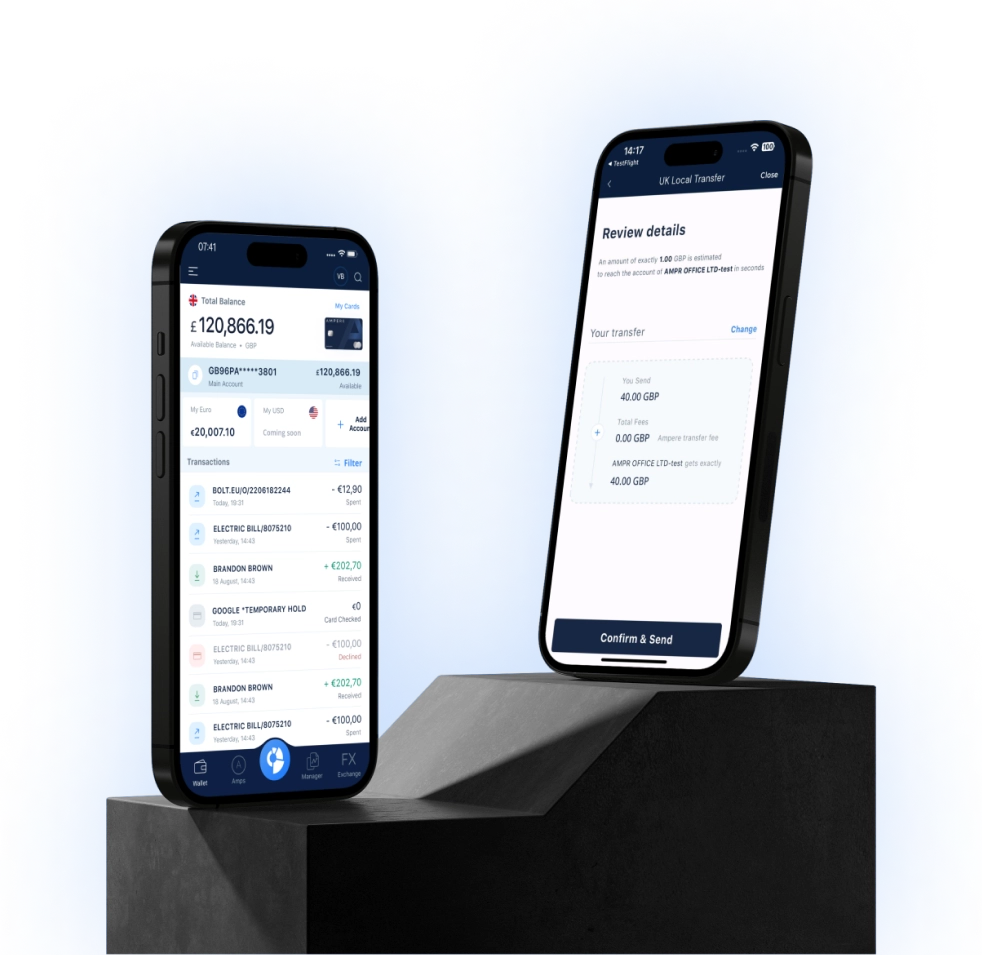
An Ampere GBP account comes with a sort code, account number and IBAN, so your clients have what they need to pay you. Sending money out by Faster Payments costs £0. Open an Ampere account online and your company's details will be ready for that next client email.
Name check
For years, the sort code and account number were the only details a UK payment went by. Confirmation of Payee added a name check on top.
When you pay someone new, the name you enter gets compared with the name held on their account, and you see the result before you send. You'll usually get a match, a close match with the account's real name shown, or no match.
The Payment Systems Regulator made the check compulsory in stages, and by the end of October 2024 every provider using its own unique sort codes had to offer it.
A close match can pop up over something as small as a missing "Ltd," and updating the name usually fixes it. If you get no match, check the details with the person you're paying before the money goes anywhere.
Typos happen, and many providers and payment apps run a quick maths check on the sort code and account number together, called modulus checking, so a lot of typos get flagged before anything is sent.
If a payment does go to the wrong account, tell your provider as soon as you notice.
UK banks and building societies that offer Faster Payments follow a Credit Payment Recovery process, where your provider should act within two working days and contact the receiving provider for you.
When you're the one getting paid, put your sort code, account number and company name on every invoice. Using the exact name on your account helps your customers' Confirmation of Payee checks come back as a match, so the money reaches you with fewer questions.
Next time a client asks for your details, you'll have all six digits ready before they've finished typing.