Which Merchant Category Code Does Your Business Need?
Look at your last card statement and you’ll see lunch filed under restaurants and a train ticket under travel. Those labels come from a four-digit merchant category code (MCC) that every card-accepting business has.
Once your company starts taking card payments, it gets one too.
Who sets your merchant category code
Your acquirer sets the code when you open a merchant account. It picks the MCC that best matches your main line of business, based on what you tell it in your application.
The codes come from an international standard, ISO 18245.
Visa and Mastercard each publish their own list built on it, and the description for the same number can differ slightly between the two.
Visa keeps its list in a merchant data manual that it updates regularly as new codes appear, and their rules say the code should reflect where most of a merchant’s sales come from.
A shop that mostly sells books, with a small shelf of stationery by the checkout, gets the bookshop code, 5942.
MCC code meaning, number by number
You’ll find the MCC code meaning in the short description that comes with each number. The numbers themselves are grouped loosely by type of business.
Codes in the 4000s are mostly transport and utilities. The 5000s cover shops and restaurants. The 7000s mix hotels, personal services and business services, and the 8000s are professional services and membership organisations.
Codes ending in 99 are usually catch-alls for businesses with no better fit, like 5999 for miscellaneous retail or 8999 for professional services not elsewhere classified. Acquirers are only meant to use them when nothing more specific fits.
Airlines, car rental companies and hotel chains break the pattern. The biggest brands have a code of their own in the 3000s. British Airways is 3005, easyJet is 3245 and Premier Inn is 3811.
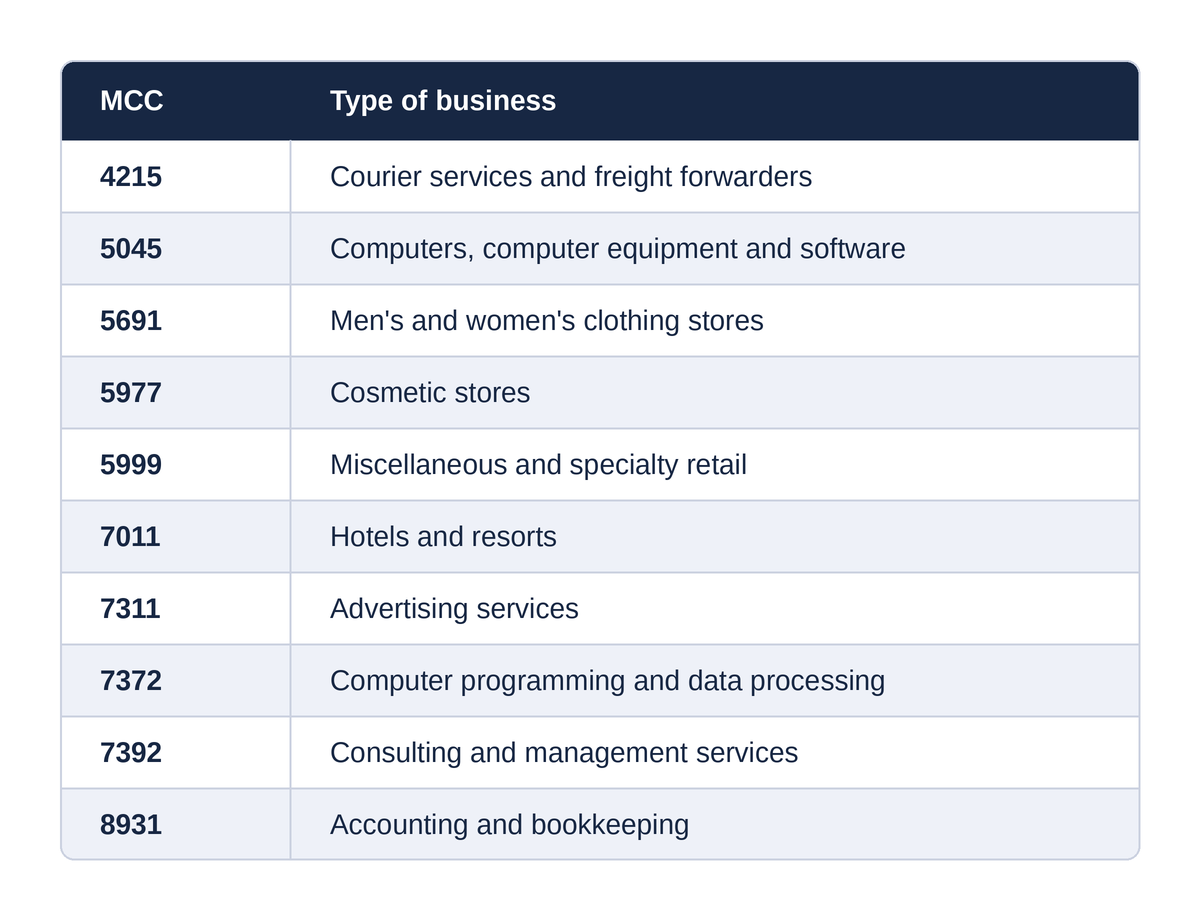
The full list runs to hundreds of codes once you count the individual airline and hotel brands, so if your type of business isn’t here, your provider can point you to the right one.
Why your code matters
Your MCC travels with every payment, and some decisions hang on it. Visa says it and its member institutions use the code for reporting, tracking activity and managing risk.
A few categories carry extra weight.
Visa marks a short list of codes as high integrity risk, including betting (7995) and dating services (7273), and merchants in those categories go through extra registration and checks before they can take card payments online. Many UK card providers also let customers switch on a gambling block, which declines payments coded 7995.
For most businesses, the bigger problem is a code that doesn’t match what you sell.
A vague catch-all can lead to more questions from your acquirer, and a code in the wrong category can mean declines from customers whose cards are set to refuse it.
Your code also decides where your payment lands on your customers’ statements.
Companies that issue cards to staff can block whole categories, and finance teams often sort spending by them. If a client sees your invoice payment filed under the wrong heading, it becomes one more line they have to check.
If you’re setting up card payments for a UK company, an Ampere merchant account lets you accept Visa and Mastercard payments online from cards issued in any country. Once your Ampere business account is approved, you can apply for one. The merchant account has its own review, and pricing is a custom quote for your business. Apply for a merchant account
If you’re still working out how the two accounts fit together Business account or merchant account walks you through it.
When your business does more than one thing
Visa’s rules give a business with more than one line of work two options. You can run everything under the code for whichever line brings in the most sales, or use a separate code for each one.
Some setups need separate codes either way.
If a bookshop opens a café in the corner with its own name and its own till, the café gets a restaurant code and the bookshop keeps 5942. Separate websites selling different things each get their own code too.
Businesses change as well. A salon that starts earning more from spa treatments than haircuts may need to move from 7230 (barber and beauty shops) to 7298 (health and beauty spas), or split the two.
Visa recommends reviewing codes from time to time, so if your sales mix shifts, tell your provider.
Finding the code for your business
Your MCC is usually listed in your merchant agreement or the onboarding documents from your acquirer. If you can’t find it, your provider can tell you, and it’s a fair thing to ask before you start taking payments.
When you apply, describe your business the way a customer would see it: what you sell, how you sell it and where most of your income comes from. A clear description makes it much easier to land on the right four digits.