
If you own more than a quarter of a UK company, you’re a person with significant control, and your name sits on a public list at Companies House.
For most small companies, the list is short. It’s you, or you and whoever you started the company with.
What is PSC? Companies House uses it as shorthand for person with significant control, and once you know it, you’ll spot the letters all over the place, from your company’s page on the register to form names like PSC01.
Mostly, it comes down to a quarter.
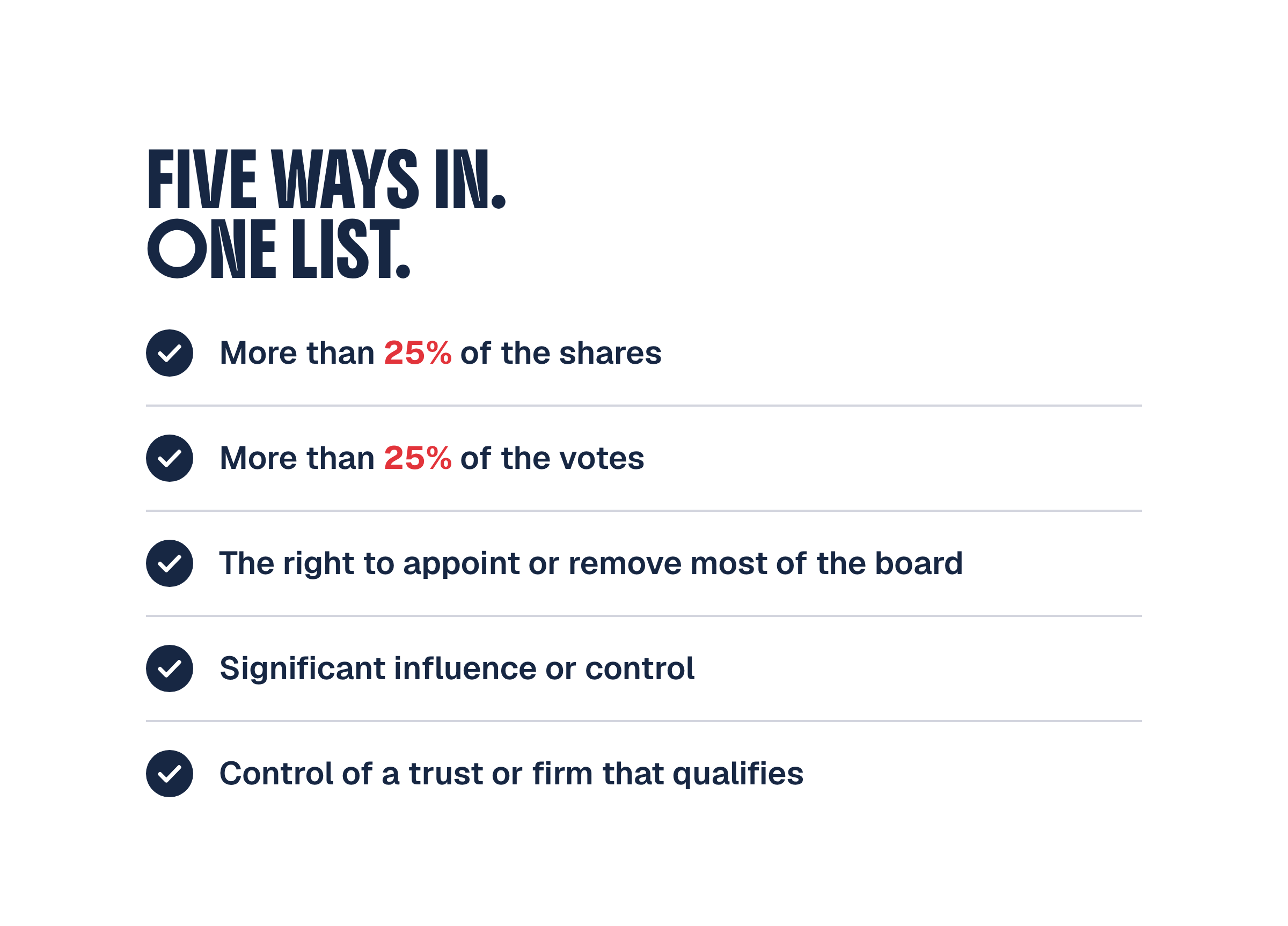
You’re a PSC if you hold more than 25% of the company’s shares or more than 25% of the voting rights. You also count if you have the right to appoint or remove most of the board, even with a small shareholding.
And there are two less common routes: having significant influence or control over the company in some other way, or controlling a trust or firm that would count under one of the rules above.
Small companies rarely get near those, and the government keeps separate guidance for the ones that do.
The word “more” matters a lot. Four friends who split a company evenly, 25% each, aren’t PSCs through their shares, because nobody has more than a quarter.
If the four of them have agreed to always vote together, they all are. And if nobody qualifies at all, the company tells Companies House it has no PSC.
A 50/50 split with your co-founder is simpler. You’re both on the list.
Directors get onto the list through shares, votes or control, like everyone else.
A director who runs the company day to day but owns no shares and has no special rights usually stays off it, because the official guidance treats doing a director’s normal job as an “excepted role”.
And if you own the whole company and run it too, you’re its PSC. Of all your company paperwork, the PSC list is one of the quickest jobs.
If your company sits under a holding company, the list starts to look a bit like a family tree. When the parent is a UK company, it goes on your list as a “relevant legal entity”, and the people behind it appear on the parent’s own list. A parent based abroad usually can’t go on the list, so you keep following the tree upwards until you reach a real person.
LLPs have PSCs too. Here, you count if you’d get more than a quarter of the money left over if the LLP closed and paid its debts. Votes and control work much like they do in a company.
If you share the company with a co-founder or two, it’s easier to manage the money together when everyone has their own login. With an Ampere business account, you can add co-owners, directors or your accountant, each with the access you choose.
When you apply, we ask who’s behind the business, so with your PSC list up to date, you’ll have the answer ready.
Being a PSC puts a few of your details on the public register, like your name, nationality, the month and year you were born and how you control the company. Your home address and the exact day of your birthday stay private, so no surprise birthday cards from strangers.
Your service address is public too, so if you put your home address there, anyone can see it.
If someone sells their shares, a new investor comes in or a PSC moves to a new address, you have 14 days from confirming the change to update Companies House.
The list can never be empty.
If your company has no PSC, or you’re still working out who it is, you tell Companies House why. And once a year, you confirm it’s all still accurate when you file your confirmation statement.
It works both ways, too. If you become a PSC and the company hasn’t been in touch, it’s up to you to tell them within a month of finding out, and you also have a month to pass on any later changes.
Every PSC also has to verify their identity with Companies House. Once you do, you get a personal code that links your verified ID to your PSC role.
If you became a PSC after 18 November 2025, you can give the code when you’re added to the register or within 14 days.
Take a minute to look at your company’s PSC list on the Companies House register. If someone has sold shares or you’ve brought in a partner since you set up and the list still shows the old setup, update it now so it matches who owns and controls the company.